


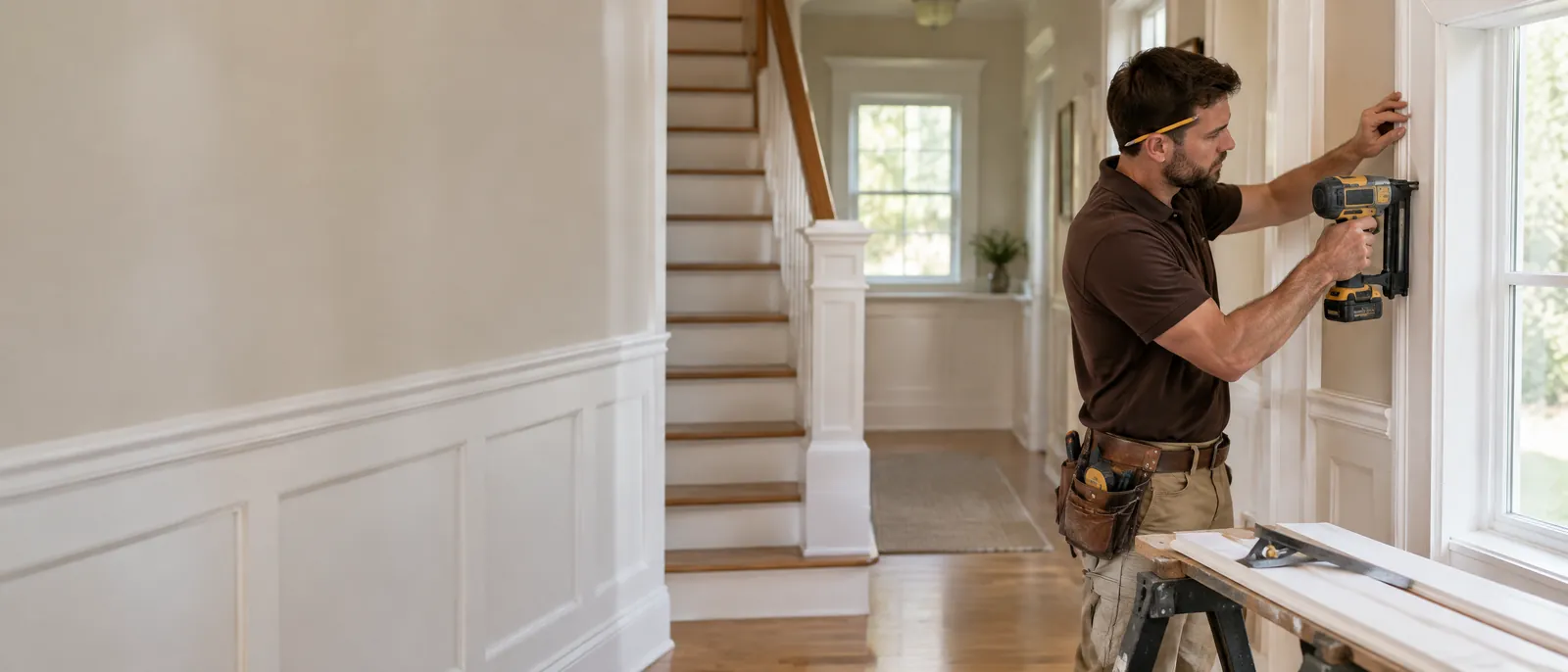
A room can have new floors and fresh paint and still feel unfinished. What is usually missing is the trim. Trim covers the places where different materials meet and it draws the lines the eye follows around the room. When those lines are straight and the joints are tight, nobody notices the trim. When they are not, it is all anybody sees.
Door casing
Casing is the molding that frames a door or a window and covers the gap between the frame and the wall. The detail that matters most is the reveal: the narrow, even strip of door frame left showing between its edge and the casing. If the reveal is the same all the way around, the door looks square. If it widens and narrows, the door looks crooked even when it is hung perfectly plumb.
Baseboard
Baseboard covers the joint between wall and floor, and it protects the wall from shoes, vacuums and furniture. The challenge is that walls are rarely straight and floors are rarely level. Good baseboard work follows the room without showing it: at inside corners, one piece is cut to the profile of the other so the joint stays closed as the wood moves; outside corners are mitered; and on long walls the pieces are spliced with an angled cut instead of a butt joint.
Wainscoting
Wainscoting is paneling on the lower part of a wall. It protects walls in the places that take the most abuse, such as hallways, stairways, dining rooms and mudrooms. Most of the work is in the layout. Panels should be evenly sized across each wall, and the spacing is planned around outlets, windows and door casings so that no skinny leftover panel ends up in a corner.
Built-ins and stairs
Built-ins are bookcases, window seats, mudroom benches and cabinets made to fit one specific spot. What sets a built-in apart from ordinary furniture is the fit: the edges are scribed, which means shaped to follow the wall, the floor and the ceiling, so the piece looks like it was always part of the house.
Stairs are the most demanding finish carpentry in a home. Treads, risers, skirt boards, railings and balusters all meet at angles, at eye level and at hand level. You see every joint on the way up and feel every one under your hand.
Why miters and reveals matter
A miter is two pieces cut at an angle to meet at a corner. A tight miter reads as one continuous piece of molding; an open one shows a dark line. Because wall corners are almost never perfectly square, the angle is cut to fit the actual corner, not the number on the saw. Reveals work the same way: when they match from door to door and window to window, the whole room looks straight.
Caulk and paint-ready joints: the last 5%
The final pass is a small part of the job and a large part of the result. Before the painter arrives, the trim should be ready for paint:
- Nail holes filled and sanded flush
- Wood-to-wood joints tight, glued where needed and sanded smooth
- A thin, even bead of caulk where the trim meets the wall, to close the shadow line
Caulk is a finishing touch, not a filler. It closes a hairline between trim and wall; it does not rescue a joint that was cut badly.
MZ Finish Work does finish carpentry (door casing, baseboard, wainscoting, built-ins and stairs) in Massachusetts and Rhode Island. Call or text (774) 433-6868, or send the quote form, for a free estimate.


Comments (0)
Be the first to comment.